
Emma Heming Willis Advocates for Caregivers
Most people had likely never heard of frontotemporal dementia (FTD) until we learned in February 2023 that beloved actor Bruce Willis had been diagnosed with the disease. While FTD is a type of dementia, it is different from the more commonly known Alzheimer’s disease. When Willis and his wife, Emma Heming Willis, were told Bruce had FTD, Heming Willis was handed a pamphlet and sent on her way. She describes a “crushing sense of fear and uncertainty.”
As she navigated this journey, she decided to write the book she wished someone had handed to her three years ago. The result is “The Unexpected Journey: Finding Strength, Hope, and Yourself on the Caregiving Path,” which was published in 2025 and became an instant New York Times bestseller. Heming Willis has said the book is not meant to be a guide on how to be a caregiver. Instead, “it’s about how to care for yourself while doing one of the hardest, most heartbreaking jobs in the world.” In the description of her book, she said, “Through my own experience and insights from leading experts, I hope to help other care partners feel less isolated, better prepared and empowered to navigate this journey with strength and support.”
BrainWise recently interviewed Emma Heming Willis about her husband’s diagnosis, her caregiving journey, and the advice she has for other caregivers—and those who want to help the caregivers they know.
This Q&A has been edited for length and clarity.
BrainWise: You know that the world loves Bruce Willis. But what made you fall in love with him?
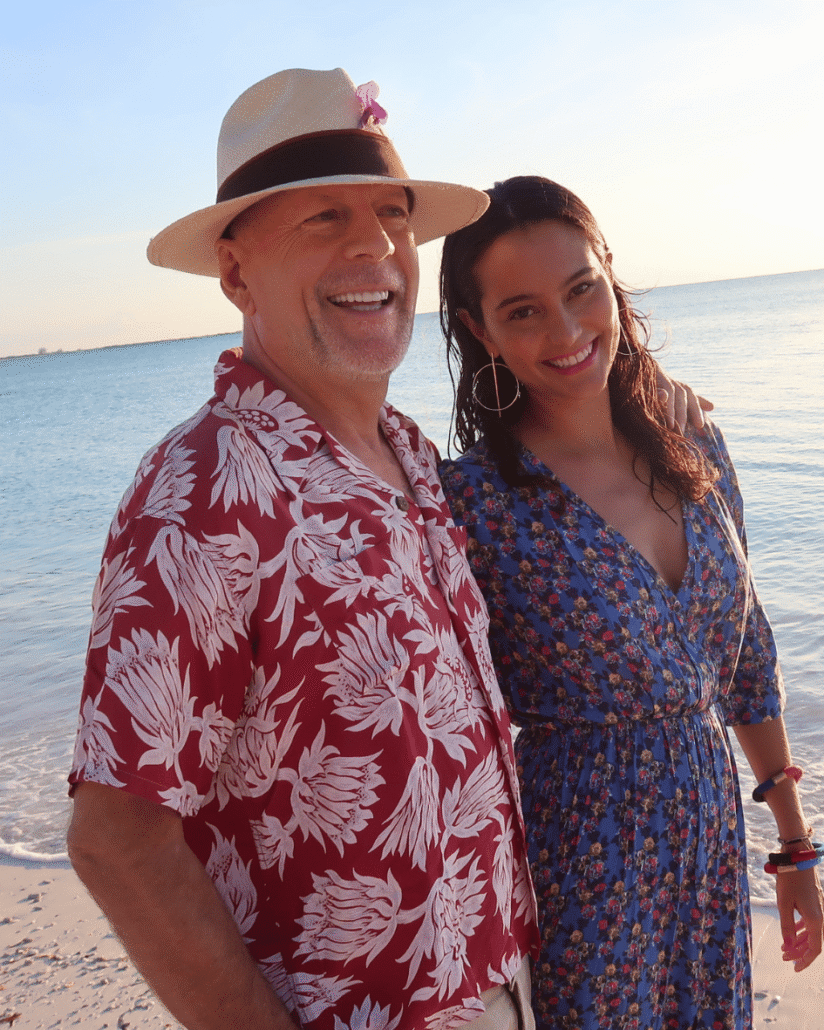
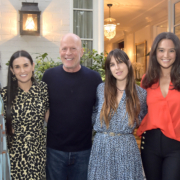
Emma Heming Willis: When I first met Bruce, what really stuck out to me was just how down to earth and very humble he was—very approachable. He’s so beloved by the world and so famous, but he really tried to remove that when you were with him, to find a real human connection. And I got to see him as a family man, as a father to his three older girls, and how important being a father to him was—I think it’s his most important role. He was someone very easy to fall in love with, and I did, and I’m so happy that I did. And we have two incredible children. He’s a girl dad and really just one of the greatest girl dads I know.
Bruce was first diagnosed with aphasia in 2022, and then at the end of 2023, you received a more specific diagnosis of frontotemporal dementia. What were some initial signs that something was wrong?
What I noticed was that Bruce’s stutter started to come back. He had a severe stutter as a child, but with acting, he was able to control it. But I would notice that at times, his stutter would come up, and that was confusing to me, especially because he wasn’t acknowledging it. And, our communication was a little off—things that we were aligned in in our marriage, we weren’t anymore. So it was really this communication and understanding piece that was off. FTD doesn’t scream; it whispers. Never in my wildest dreams would I think that this was some kind of young-onset dementia that was creeping into my husband’s brain.
What was receiving the FTD diagnosis like?
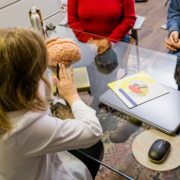
Listen, when we got that diagnosis, that was not the diagnosis I thought we were going to be receiving that day. I had heard of FTD before, and what I had heard was that it was the worst of the worst and it’s the one that you don’t want. And when we received that, I didn’t hear another thing after that. … It was a lot to process all at once, and because there are no treatments and there are no cures, we left with just a “check back in a couple of months” and were sent on our way. That was a super traumatic experience to feel like I was about to navigate something that I didn’t truly understand.
What I wish was that we would have been sent away with some kind of roadmap or that [someone] would have pulled me aside and said, “I know this feels terrible right now, but just know that there is support out there for you.” Even if they would have just sent me away with, “Reach out to The Association for Frontotemporal Degeneration. Go on their website, and you’re going to see everything that you might need to begin to understand what this disease is.”
But we walked away with nothing. And it’s one of those diseases where your partner’s not able to help you figure that out, as opposed to a cancer diagnosis or something. And we have two young children—our daughters were 8 and 10 at the time. So, I was wearing a lot of hats and doing a lot of things while trying to protect my husband’s privacy.
In 2025, you shared that you moved your husband into a separate home near yours, where he can have round-the-clock care. And you received a lot of criticism. Can you share why you made that decision?
These decisions are not made lightly, and there was a lot of thought and care and a lot of love that went into that decision. I had to make a decision that would be the safest for Bruce and for our young daughters, and as hard as that decision was, how things are today is like night and day.
Bruce is in our second home that supports his needs 24/7 safely, and our children are in a home that supports their needs. Because I’ll tell you, people don’t understand all the needs that are not met behind closed doors when you are managing someone with FTD, as well as raising two young daughters. I was just trying to manage all of that while protecting them and keeping my husband safe, and it’s a lot. And we are privileged that this was something we could do, and it is turned out to be the hardest, yet the best, for everyone. Our girls can have a life of playdates and sleepovers, which they never had before.
Sometimes caregivers have to make that really hard choice, and there is so much guilt and shame around making that decision—which ultimately was the right decision. But, it was hard to conceptualize and to think that this is what I’m about to do.
I wanted to be very transparent about it for other caregivers. I knew how much criticism I would get; I was very prepared for it. But it’s unfortunate for other caregivers who have to make that decision—if they’re going to put their person into a care facility or whatever that might look like that—to be criticized. They’ve already put so much on themselves with the guilt and the shame, and then to also get that from family and friends is not right. Every care plan is different, and we just have to do what’s best. And only we know what’s best for our family.
“Sometimes caregivers have to make that really hard choice, and there is so much guilt and shame around making that decision. … Every care plan is different, and we just have to do what’s best. And only we know what’s best for our family.”
What do you want to say to other caregivers?
There’s a chapter in my book that’s really dedicated to family and friends because I think people want to show up, they want to help, but they don’t know how. When someone says, “If there’s anything I can do, please let me know,” it’s very hard on the fly for caregivers to be like, “Oh yes, I need this, that or the other.” And then what are the boundaries and parameters around that?
I just ask caregivers to think about the things that they do in a day, in a week, in a month, that they can hand over to someone else, because as caregivers, we are doing all of it. We don’t want to be a burden to someone else. We don’t want to ask. But what’s important, and what caregivers need to do is that when someone is asking to help you, accept the help and have a list ready to say, “Can you drop a lasagna off at my house once a month? Can you go fill my car up? Can you pick my kids up from school?” Or, the person who is offering the help can say, “Here are three things I can do for you this week. Please let me know what would work for you.”
Caregivers need to accept the help because so many are doing it on their own because they don’t want to be a burden. They don’t want to ask for help. They might think that they’re a failure because they’re asking for help. But caregiving is not a solo mission.
People need to be able to put the right support that they need into place—if it’s formal caregiving, if it’s reaching out to family and friends. Building that community is really important to be able to sustain the journey of caregiving.
My wake-up call was learning about the statistics: Caregivers are sometimes dying before the person that they’re caring for, and that was really alarming to me. I didn’t know that caregiving can be so bad for your health. We’re thrust into this role without any knowledge. We’re learning things on the fly. That’s why in my book I help caregivers understand that in order to sustain this, we must care for ourselves first and foremost, so that we can continue to give the best care to the people we love.
Tell me more about why you wrote this book.
The book really came from that traumatic experience [of how we were given Bruce’s FTD diagnosis]. This is the book I wish someone would have handed me the day we walked out of that appointment, so that I knew that there was support, that I knew that caring for myself wouldn’t be selfish, but self-preserving.
I wanted caregivers to know that they’re not alone. A lot of the comments I hear from people after they’ve read the book is they feel validated, they feel seen, and that’s really important too. The book is very pragmatic. I give very actionable, tangible ideas to the caregiver on how to get support for themselves and how to seek support for their loved ones, so that we can sustain the caregiving journey that goes on for a long time.
What are you working on next?
I’m working with Dr. Bruce Miller at UCSF on a caregiver roadmap. I talked to him about when a caregiver walks out with a diagnosis that they should be given some resources. The roadmap could explain: What is FTD? What does that look like? What kind of team do they need to put around themselves? What are the right resources? The idea is to take this template and share it with other neurologist offices and hospitals.
How are you, Bruce and your girls doing now?
All things considered, we’re all doing well. Bruce is doing well with an unkind disease, but we’ve been fortunate to have built an amazing team of caring, compassionate people that support our needs. I’m with doctors that finally listen to me.
I think I’m doing the best that I can. I mean, it’s hard; I’m in the thick of it, and I can’t say that it’s easy. But I have the right support now. I have a community—coming out of that initial isolation of it has been very beneficial for me. And my healing with writing the book, being able to connect with more people, has been important for me and my mental health.