The Reality of Long-Term Caregiving
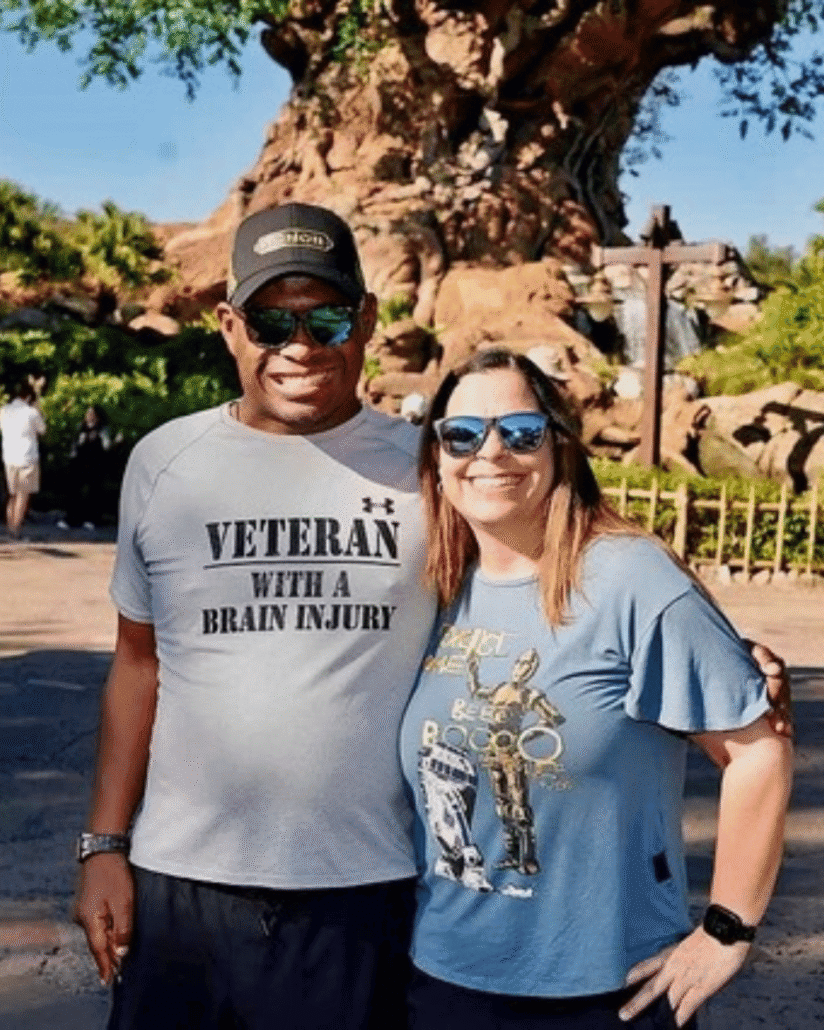
Nikki Davis is a private person. Now age 46, she lives in the Tampa Bay, Florida area, with her husband, Ernie. She doesn’t share a lot about her home life with colleagues and acquaintances. In fact, many of her co-workers at the medical device company where she works didn’t know that she has been a caregiver for the past 15 years to her husband. In 2010, Ernie suffered an anoxic brain injury (caused by lack of oxygen to the brain) after what should have been a routine shoulder surgery.
But in the fall of 2025, when Davis realized they were coming upon the 15th anniversary of Ernie’s brain injury, she decided to write about her experience with caregiving, specifically about the reality of long-term caregiving. For 15 straight days, she shared a post each day on Facebook and LinkedIn explaining what long-term caregiving truly looks like and how it has affected her life. (You can read Davis’ 15 posts on LinkedIn; start with the October 16, 2025, post.)
BrainWise recently interviewed Davis about her experience and what she wanted people to take away from her 15 posts.
This Q&A has been edited for length and clarity.
BrainWise: How did you and Ernie meet? And what was your life like before his brain injury?
Nikki Davis: We met on Match.com, living in DC, in February 2005. I loved Ernie’s energy and how fully he showed up in life. He was competitive, passionate and always chose to be with me. In big and small ways, he made it clear that I was his person. He was an Army veteran and was serving in the Army Reserve at that time, and I worked for a veterinary clinic doing patient outreach. We got married November 3, 2007.
We ended up moving to Florida, to the Tampa Bay area, where I’m from. Ernie was really excited about that because he liked the idea of playing sports all year-round. He was really active in semi pro football and softball leagues, and he worked in administrative support at the James A. Haley Veterans’ Hospital in Tampa.
Tell me what happened on October 29, 2010.
We don’t really know what happened. It was a routine shoulder surgery. This was Ernie’s third shoulder surgery. He had torn his rotator cuff and bicep tendon during an Army Combatives course, and this procedure was meant to remove scar tissue—a simple, 30-minute surgery.
Everything went well during the surgery. Afterward, the surgeon was talking to me when someone on the anesthesia team went to wake Ernie up and something happened. He went into cardiac arrest, and he went without oxygen for about 15 minutes while they tried to resuscitate him.
They got him back, but in the first few days, we didn’t actually know he had a brain injury. It wasn’t until a few days after that he started having movements in his body that the neurologist was like, “I think we’re dealing with a brain injury.”
Ernie was at the community hospital for about two weeks, and then he transferred to the James A. Haley VA. He was there for eight months. He had to learn to drink, eat, walk, talk, relearn everything.
What is Ernie’s condition today?
He is considered incapacitated and has significant cognitive deficits. He often doesn’t know where he is or how old he is, which means he requires 24/7 supervision. He can eat, drink, walk and talk, but he doesn’t reliably communicate his needs or tell you when something is wrong. Instead, you have to read his behavior and anticipate what he needs. I call that “mind vision.”
He knew who I was, then he didn’t, and now he does again. That’s been hard to explain, but as his brain has healed, some things seem to have come back while others are still uneven. Over the last three years, we’ve seen more cognition and the return of memories that weren’t there before. Sometimes he calls me his “girlfriend” instead of his “wife,” but he always knows that I’m his person.
Is he still engaged in rehabilitation?
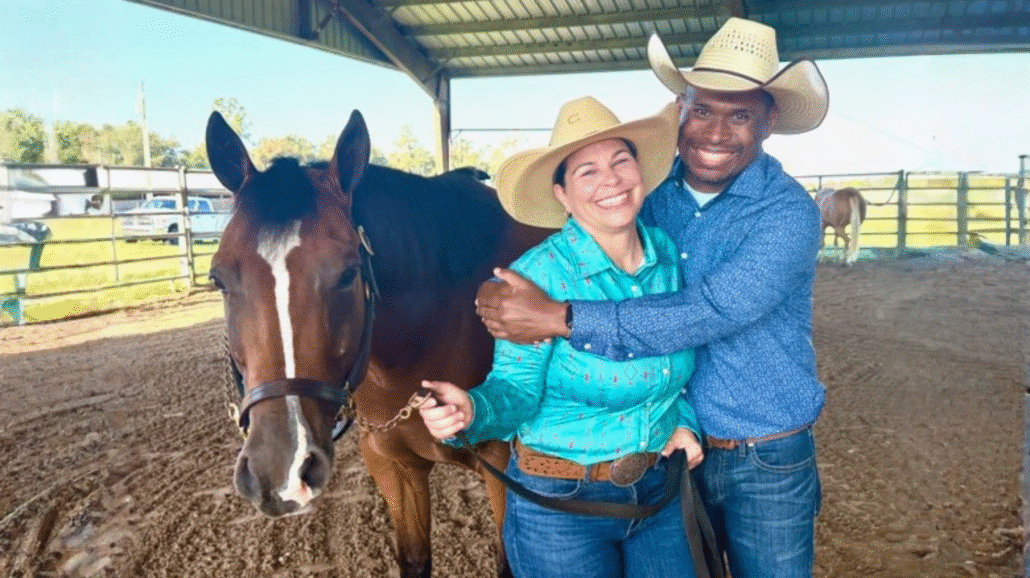
I’ve put together a structured program for him that goes beyond traditional therapies, which can be difficult to sustain consistently through insurance. Ernie follows a consistent Monday-through-Friday schedule that blends therapeutic, physical and cognitive engagement. His care includes music therapy, personal training at the gym, art therapy, therapeutic horseback riding and massage. Through the Wounded Warrior Project, he also works with a recreational therapist who takes him out for activities like bowling, archery and other physical experiences that support engagement and motivation.
Outside of formal sessions, his caregivers are trained to incorporate cognitive and physical stimulation into daily life through games, trivia and other activities. He has 24/7 caregiver support, though that doesn’t mean I’m hands off. I remain very involved in his care while also working remotely three days a week.
Our ability to sustain this care model is closely tied to Ernie’s military service. The VA and TRICARE for Life cover many aspects of his care, which allows us to prioritize consistency and long-term planning in a way that isn’t always possible for civilian families.
Why did you decide to write your 15 Years, 15 Truths posts?
I’m not someone who usually talks publicly about caregiving, but as I approached the 15-year mark, I saw an opportunity to reflect more honestly. By that point, caregiving is no longer driven by crisis. You move into a maintenance phase. Early on, there’s the trauma and chaos, then a period of problem-solving and adaptation, followed by a stretch where progress feels possible and hope feels active. Fifteen years in, you reach a different reality. This isn’t a phase anymore. This is life.
I have many caregiver friends who are in a similar place, 12 or more years out, some military, some civilian. And almost no one talks about this stage. There’s a real fear that if you say certain things out loud, you’ll be judged for them. I decided to talk anyway. I shared posts about experiences and thoughts that I suspect many caregivers have but don’t feel free to express. Some of it was for others. Some of it was simply me giving voice to what I hadn’t said before.
What was the response like?
I’m glad I did it because I got a lot of response—and not from people I thought I’d get responses from. In one of my posts, I said, “Look, don’t hug and pray and thank me. That’s not what this is about. It’s about you understanding so you can either help somebody in your world who is caregiving, or—fun fact—we’re all going to be caregivers at some point of somebody.”
The response was thoughtful and respectful. People asked questions. Colleagues I’d worked with for years reached out, many of whom didn’t even know I was a caregiver. Other caregivers told me, “I couldn’t have written this myself, but it says exactly what I feel” or “I didn’t realize what I was feeling until I read it.” I also heard from people who were just beginning to care for a parent and said it helped them make sense of what they were experiencing.
In one of your posts, you talked about how the word “wife” disappeared. Can you explain that?
Once caregiving enters the picture, the word “wife” starts to disappear. People stop speaking to you as a spouse and begin addressing you as a “caregiver.” In my case, that shift is also legal. I am Ernie’s court-appointed guardian, not just his wife. Each year, we go before a judge to renew that guardianship, and Ernie is formally referred to as a “ward of the state.” It’s a stark reminder of how caregiving can reshape not only daily life, but identity and language as well.
Do you still think of yourself as a wife? Does it disappear for you too?
In many ways, the intimacy that comes with partnership changes. Not intimacy in a sexual sense, but the kind that comes from sharing your inner world with another person, talking things through at the end of the day, venting, making plans, holding shared goals and dreams.
In our situation, much of that has faded. That’s why, most days, I don’t feel like a wife. I feel like a caregiver. And then there are moments when Ernie will look at me or say something, and I recognize him immediately. In those moments, I think, “That’s the guy I married.”
You also wrote about another subject that people don’t often talk about: anger.
There’s a lot to be angry about as a caregiver. Everyday situations add up. Being out in public, navigating doctor’s offices with people who don’t understand brain injury, constantly compensating for systems that weren’t built for this. Over time, it weighs on you. What surprises me is that the anger often shows up around something small, like realizing a supply wasn’t restocked. Suddenly it all traces back to the beginning, to how we got here in the first place. I think it’s OK to be angry about that, even though many caregivers feel guilty admitting it.
What else do you want people to know about caregiving?
Long-term caregiving is incredibly demanding, and over time people often stop seeing you as a caregiver because you make it look manageable. What gets missed is that there are very few systems in place to support caregivers over the long haul, especially when it comes to financial strain and meaningful respite.
If someone read the posts I shared without any prior understanding of caregiving, I hope they came away thinking, “That’s a lot.” That there are layers and responsibilities most people never consider. And maybe that awareness carries into everyday life. Maybe the next time they see someone struggling in public with a person who has a disability, they pause before judging and choose to be more patient, helpful and compassionate.
In 2020, you bought a farm. Tell me about that and what it’s meant for you and Ernie.
I bought a 52-acre farm, Mahogany Farms, with one clear goal: to create a place where Ernie can walk around and be safe. He’s considered a wanderer. He needs to walk, and I wanted an environment where he could do that without constant risk. I’m a horse person and had never interacted with cows before, but the property came with them, and we built from there.
We live in a barn on the property, with a house as well, and over time we’ve added animals, including miniature cows, horses and miniature donkeys. The farm has become an active, engaging environment. Ernie can be outside, see things, move, and be around people and animals throughout the day.
I genuinely believe it has supported his recovery. Over the past few years, we’ve seen huge improvements in his cognition, and the combination of movement, stimulation and routine has made a real difference. It’s been a wonderful journey.